
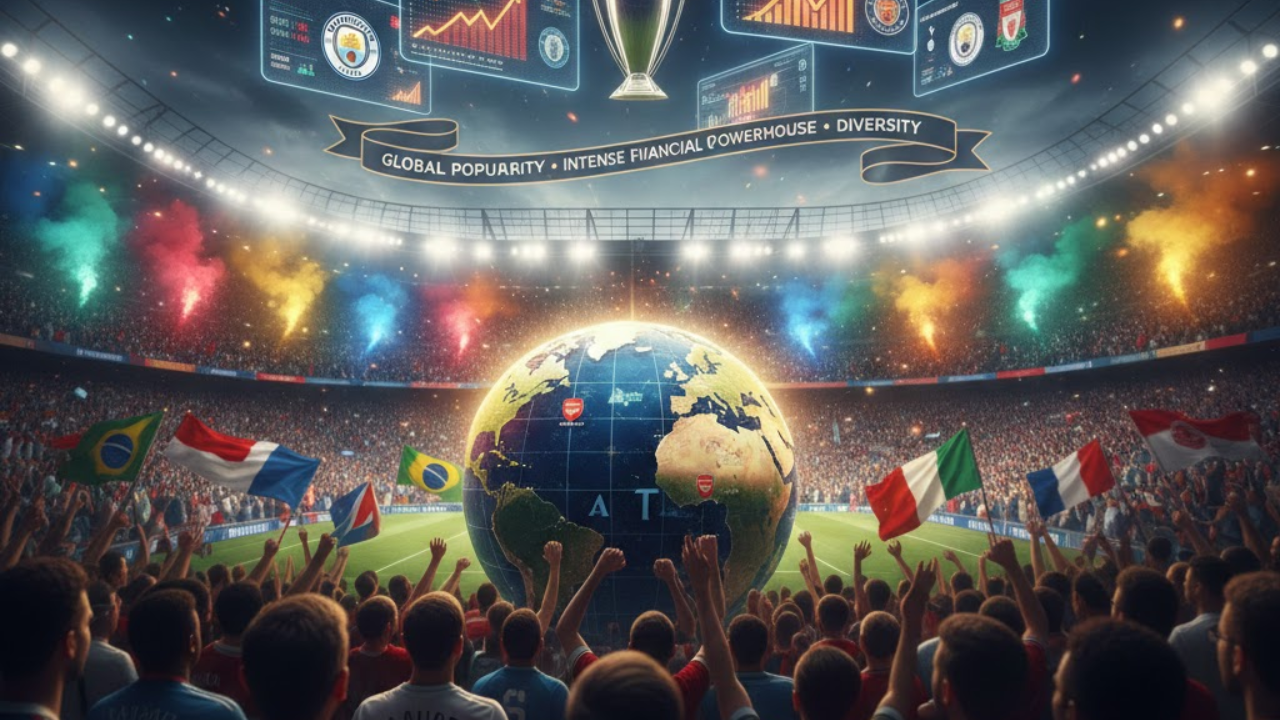
European football is home to some of the world’s most competitive and iconic leagues, but one league consistently stands above the rest—the English Premier League (EPL). From global popularity and intense rivalries to financial muscle and unmatched diversity, the Premier League has established itself as the benchmark for modern football.
While Bundesliga’s Bayern Munich and Ligue 1’s PSG have historically dominated their leagues, and La Liga has featured legendary eras of Real Madrid and Barcelona, recent seasons have shown surprising underdog stories. Bayer Leverkusen’s rise under Xabi Alonso and Brest’s push in Ligue 1 highlight that football’s landscape is evolving.
Yet, despite these shifts, the Premier League remains the most powerful, widely followed, and commercially successful league in Europe. Here’s a deep dive into what truly sets it apart.
1. Global Popularity, Smart Commercialization & Mass Appeal
When new fans step into the world of football, their journey often begins with the Premier League—and that’s not accidental.
Language Advantage
English, being the most widely spoken second language worldwide, naturally elevates the Premier League’s accessibility. Fans from Asia, Africa, Europe, and the Americas can easily consume commentary, interviews, and analysis without language barriers.
In contrast, leagues like Bundesliga or Ekstraklasa face linguistic limitations that make player names, team pronunciations, and media content harder for international audiences.
Brilliant Commercial Strategy
The Premier League markets itself as the most exciting league in the world—and the world believes it.
From top-tier jersey collaborations with Nike, Adidas, and Puma to global broadcast partnerships and mega social media engagement, EPL’s branding is unmatched.
High-definition stadium experiences, iconic club rivalries, and aggressive marketing campaigns create a product that is not just a sport—but a global cultural phenomenon.
Conspicuous Consumption
Football fandom has become a lifestyle symbol. Wearing a Premier League jersey or supporting a Big Six team carries a form of social prestige.
Many “casual viewers” follow the Premier League simply because it feels elite, trendy, and globally relevant. Its reputation makes fans feel like they’re part of an exclusive worldwide community.
2. Intense Rivalries & Genuine Competition
The Premier League is widely regarded as the most competitive major league—and fan surveys consistently support this. Unlike La Liga, where Real Madrid and Barcelona dominate, or Bundesliga and Ligue 1, where Bayern and PSG often win without challenge, the Premier League offers unpredictability every weekend.
In the 2023–24 season alone, teams like Wolves, Brighton, West Ham, Bournemouth, Crystal Palace, and Aston Villa have all beaten Big Six clubs. This level of competition is rare in other leagues.
Championship Winners Across Top Leagues (All-Time):
- Premier League: 7
- La Liga: 9
- Serie A: 16
- Bundesliga: 12
- Ligue 1: 18
While Serie A and Ligue 1 have more historical variety, the EPL consistently offers multi-team title races, making it exhilarating for fans and broadcasters alike.
3. Diversity: A League That Embraces Global Talent
Diversity is one of the Premier League’s strongest pillars. Clubs actively recruit top international players, making the league a melting pot of football cultures. Initiatives like the Premier League Equality, Diversity and Inclusion Standard (PLEDIS) further strengthen its commitment to fairness and representation.
Compared to La Liga—which heavily focuses on local talent—the Premier League integrates players from dozens of nationalities, creating a truly global playground.
Why Diversity Matters
Representation inspires nations.
Just as Son Heung-min elevated South Korea’s presence in global football, many fans hope to see athletes from India and other developing football regions shine on the world stage one day.
Diversity is not just about inclusion—it’s about inspiring future generations.
4. The Financial Powerhouse: Money, Investments & Business Impact
Football today is more than just a sport—it’s a multi-billion-dollar global business. And in this business, no league comes close to the Premier League.
Financial Highlights:
- The average Premier League club is valued at $1.51 billion.
- The league’s broadcasting revenue surpasses all European leagues combined.
- Transfer fees, wages, and infrastructure investments are at unmatched levels.
Money brings access to:
- World-class coaches
- Cutting-edge analytics
- Better stadiums
- Global sponsorships
- Youth development programs
However, money doesn’t guarantee success.
As seen in the 2024 Champions League matchup where Porto beat Arsenal despite a massive financial gap, passion and tactics still dictate football.
Money may shape clubs, but it doesn’t determine the scoreboard.
Conclusion
The Premier League’s dominance isn’t accidental—it’s the result of strategic branding, competitive structure, global representation, and massive financial backing. Its ability to blend entertainment, diversity, and high-quality football has positioned it as the pinnacle of European football.
Whether it’s the unpredictability of matchdays, the electrifying environment of stadiums, or the worldwide fan culture, the Premier League continues to define modern football—setting trends that other leagues aspire to follow.
Until the next Champions League night—Força Barça.