
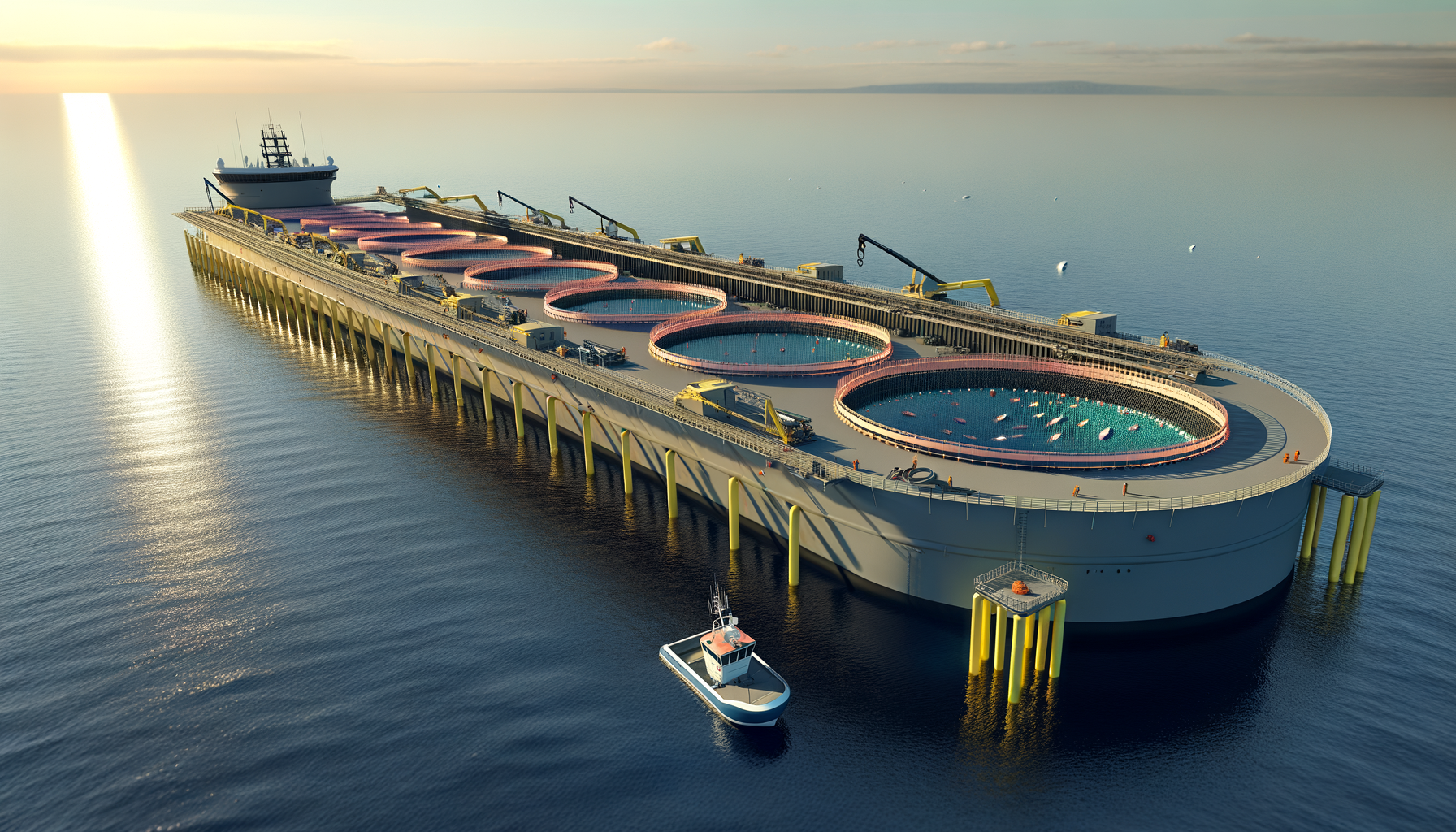
From a distance, it might look like a cruise ship or a futuristic naval vessel slicing through the sea. But in fact, what observers are seeing is a marvel of engineering: the **Havfarm 1**, the world’s largest offshore salmon farming facility. This floating giant, measuring a staggering 385 meters in length, is reshaping the fishing industry by taking aquaculture far beyond the inshore pens and fjords of conventional salmon farming. Anchored off the coast of northern Norway, Havfarm 1 is more than just a technological feat—it is a symbol of an evolving, sustainable approach to feeding a rapidly growing global population.
With mounting pressure on traditional wild fisheries and growing demand for sustainable protein, aquaculture has emerged as a critical solution. Havfarm 1, built by the Norwegian company Nordlaks and constructed by CIMC Raffles in China, showcases just how large-scale this movement has become. Designed to be stationed in exposed offshore conditions where the cold, clean sea favors healthy fish growth, Havfarm 1 hosts up to 10,000 tonnes of salmon in six massive compartments. This project doesn’t just signal innovation—it heralds a new era for the seafood sector, where **technology, sustainability, and scale converge**.
Set against a backdrop of environmental concerns and the need for efficiency, Havfarm 1 aims to reduce ecological footprints while maximizing output. By relocating fish farming away from coastlines, challenges like sea lice, waste accumulation, and pathogen transmission are dramatically reduced. The implications for marine conservation and commercial output are profound, and policymakers are taking notice. Let’s dive into how this floating colossus works, why it matters, and what the future might hold for offshore aquaculture.
Quick overview of Havfarm 1
| Name | Havfarm 1 |
| Length | 385 meters |
| Owner | Nordlaks |
| Builder | CIMC Raffles (China) |
| Fish capacity | Up to 10,000 tonnes of salmon |
| Installation site | Offshore Norway, Hadsel municipality |
| Purpose | Industrial offshore salmon farming |
Why offshore salmon farming is gaining momentum
Conventional fish farming operations, typically located inside fjords or coastal bays, have long faced criticism for their environmental impact. Problems such as sea lice infestations, limited water circulation, nutrient pollution, and interactions with wild fish stocks have pushed the need for alternatives. **Offshore aquaculture**, while more technically complex, offers high potential to bypass many of these limitations.
Havfarm 1 leverages deep, open ocean waters with better currents and temperatures suitable for healthy salmon growth. These conditions reduce disease spread and provide superior welfare for the fish. Moreover, because of its unique location and scale, **Havfarm 1 has the potential to deliver more fish with less environmental degradation**, setting a new benchmark in the global industry.
Moving aquaculture offshore isn’t just desirable—it’s necessary if we want to meet global seafood demand sustainably.
— Lars Krogh, Marine Biologist (Placeholder)
A closer look at the engineering marvel
At first glance, Havfarm 1 resembles a stationary ship. The 385-meter long platform is anchored to the seabed with massive mooring lines and is designed to hold its position even in turbulent sea conditions. The structure features six incredibly large net pens—each measuring 50×50 meters and descending 60 meters into the ocean. These form controlled environments where salmon can thrive naturally, away from harmful influences.
The platform itself acts as a working base for technicians and automated systems that maintain the fish pens, ensure continuous monitoring, dispense feed, and track water and fish health parameters. The entire operation is digitally integrated, relying heavily on **cutting-edge aquaculture monitoring systems**, machine learning, and underwater drones.
Havfarm isn’t just about farming salmon—it’s about rewriting the rules of the blue economy.
— Erik Andersson, Sustainability Analyst (Placeholder)
Environmental benefits of moving aquaculture offshore
While fish remains one of the most efficient sources of animal protein in terms of resource use and carbon footprint, critics have often pointed at the ecological downsides of intensive aquaculture. Havfarm 1 addresses many of these concerns through its design and location. Offshore operations enjoy stronger water flows that help disperse waste and reduce localized eutrophication of marine environments.
Sea lice, considered one of the most damaging parasites in fish farming, find it harder to survive in the fast-moving deeper waters. Furthermore, offshore farms like Havfarm 1 can be more tightly regulated and monitored through AI-enhanced systems and robotic inspections, cutting down on unnecessary human interventions and associated stress for the fish.
Economic and logistical implications
With Norway aiming to double its aquaculture production by 2050, projects like Havfarm 1 could prove essential. Not only does this method support **larger-batch production** with fewer localized issues, but it also decreases land use and infrastructure investment. The innovative cage system is detachable, enabling operators to move individual pens back to shore for harvest or maintenance with minimal downtime.
That said, offshore farming like this demands heavy upfront investment and logistical sophistication. Specialized vessels, trained offshore personnel, and comprehensive environmental assessments are all part of the endeavor. Yet for a country like Norway, whose fishing industry is vital to its national economy, the long-term returns are expected to outweigh the initial hurdles.
Comparing winners and losers of the new aquaculture model
| Winners | Losers |
|---|---|
| Offshore aquaculture pioneers | Traditional coastal fish farms facing stricter regulations |
| Consumers seeking sustainable seafood | Environmental polluters in the aquaculture sector |
| Technology providers in marine engineering & AI | Fish farms operating in congested and compromised environments |
| Governments promoting marine sustainability | Land-based aquaculture projects with slower scaling ability |
Future outlook for large scale offshore aquaculture
Havfarm 1 may be the first of its kind, but it certainly won’t be the last. The ability to scale seafood production in this way could significantly ease pressure on wild stocks and intensively farmed inshore systems. There are already plans for similar ventures around the world, including in parts of Asia, South America, and even North America. In the long run, **offshore farming could complement or even replace traditional methods** for many species, not just salmon.
There must be careful considerations, of course. Maritime safety, climate effects on open ocean aquaculture, and legal boundaries in international waters could all influence how fast the model replicates globally. Still, the excitement is palpable—a future where seafood farming is mostly offshore may already be on the horizon.
Short FAQs about Havfarm 1 and offshore fish farming
What is Havfarm 1?
Havfarm 1 is a massive 385-meter offshore structure designed for sustainable salmon farming by Norwegian company Nordlaks.
Where is Havfarm 1 located?
It is located off the coast of Hadsel municipality in northern Norway, in exposed sea conditions at significant depth.
How many fish can it host at once?
Havfarm 1 is capable of holding up to 10,000 tonnes of salmon in six enormous compartments.
Why farm fish offshore?
Offshore aquaculture significantly reduces environmental issues like sea lice, pollution, and disease by utilizing deeper, cleaner waters with better flow.
What is the environmental impact of Havfarm 1?
Due to its location and technology, Havfarm 1 aims to minimize waste buildup and protect surrounding ecosystems more effectively than traditional coastal farms.
Is Havfarm 1 the largest aquaculture facility in the world?
Yes, it is currently considered the largest offshore salmon farming installation with unparalleled length and capacity.
What technologies are used on Havfarm 1?
It uses AI-driven monitoring, underwater drones, automated feeders, and real-time data systems for efficient and sustainable operations.
Who built Havfarm 1?
It was constructed by CIMC Raffles in China, commissioned by Norwegian aquaculture company Nordlaks.